
Uxendon Manor Primary School
Mathematics
Overall School Vision - Every child to be the best that they can be.
Values: We show respect, we make the right choices, we roll up our sleeves.
Our Maths Vision
At Uxendon, our intent is to empower all children to be competent and successful mathematicians. We aim to deliver a high-quality mathematics education which provides a foundation for understanding the world, the ability to reason mathematically, an appreciation of the beauty and power of mathematics, and a sense of enjoyment and curiosity about the subject.
|
|

Intent: Empowering all children to be competent and successful mathematicians.
- To deliver a high-quality mathematics education which provides a foundation for understanding the world, the ability to reason mathematically, an appreciation of the beauty and power of mathematics, and a sense of enjoyment and curiosity about the subject.
- In line with the NC Objectives for Mathematics, our intent is that all pupils:
- become fluent in the fundamentals of mathematics, including through varied and frequent practice with increasingly complex problems over time, so that pupils develop conceptual understanding and the ability to recall and apply knowledge rapidly and accurately
- reason mathematically by following a line of enquiry, conjecturing relationships and generalisations, and developing an argument, justification or proof using mathematical language
- can solve problems by applying their mathematics to a variety of routine and non-routine problems with increasing sophistication, including breaking down problems into a series of simpler steps and persevering in seeking solutions.
Implementation: Enabling all children to be competent and flexible mathematicians.
- White Rose Maths (WRM) Scheme: At Uxendon, children study mathematics daily following the WRM Scheme. It is a blocked scheme, which allows for depth and breadth of learning within each strand of mathematics.
- Teaching and learning of our Mastery Approach:
- Central to our approach are the 5 Big Ideas which underpin mastery in mathematics.
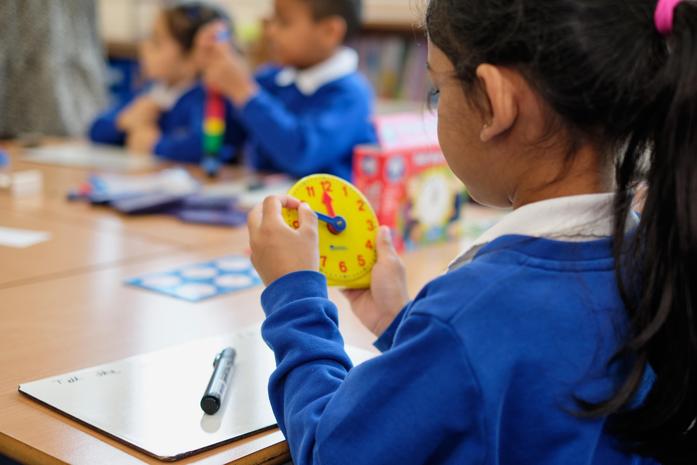
- Concrete, Pictorial and Abstract Learning: Children engage with a wide and varied range of concrete manipulatives, pictorial representations and abstract methodologies within each session. Cohesive use of CPA is a fundamental part of mastery in mathematics for all learners, not just those pupils with SEND. Concrete and pictorial references scaffold and strengthen understanding and are widely used as a teaching and learning tool from Foundation Stage to Year 6.
- Fluency, Reasoning and Problem Solving: Every learning session includes the opportunity to develop fluency skills, construct chains of reasoning using relevant knowledge alongside relevant terminology and solve increasingly complex problems in a systematic and coherent way.
- Mathematical Vocabulary: Sessions include explicit reference to vital mathematical vocabulary and the use of stem sentences to support and encourage all children to communicate their ideas with mathematical precision and clarity. These sentence structures often express key conceptual ideas or generalities and provide a framework to embed conceptual knowledge and build understanding.
- Fluent Recall: We are committed to ensuring that pupils secure their knowledge of key facts such as Times Tables and Related Divisional Facts by the end of Year 4. Our pupils engage in regular low stakes testing through Mathletics, Maths.co.uk and Urbrainy.com to practice fluent recall.
- EYFS: We understand the importance of early experiences of maths, and have committed to the Early Adopter Framework within our Early Years setting. This approach places a significant emphasis on developing a strong grounding in number – understanding that this is a necessary building block for children to excel in the subject. The two key ELG’s for mathematics are: 1. Number: Number composition, subitising, recall of bonds to 5 and 10 and doubling 2. Numerical Pattern: Verbally count beyond 20, Compare quantities, explore and represent patterns
- T&L Planning: An established and personalised long-term plan (curriculum map) and medium-term plan in place that ensures complete National Curriculum coverage. Topic cover sheets for all units are provided to enable and guide teachers and pupils - ensures all key vocabulary, representations and strategies are shared and accessible throughout the learning. Pupils should make rich connections across mathematical ideas to develop fluency, mathematical reasoning and competence in solving increasingly sophisticated problems. They should also apply their mathematical knowledge to science and other subjects.
- Formative Assessment: This is carried through AfL in each session. Feedback is given to children verbally, through self/peer assessment and through marking. Teachers then use this assessment to influence their planning. Children are rapidly identified as needing further challenge or additional support, and we ensure that this is provided in a timely manner.
- Timely Interventions: We believe that all children can achieve in maths, and focus on whole class teaching. Our interventions are focused on Pre-Teaching, Same Day Interventions and NTP.
- Summative Assessments: Children complete WRM End of Block assessments for each phase of learning. At the end of the year, NFER assessments are also used. Results are used to further inform planning and allow for tailored interventions groups to take place to ensure the objectives are secured. Our Assessment Calendar also includes 3 key dates for capturing progress and attainment against National Curriculum Objectives using TT.
- Subject Monitoring: We regularly monitor the quality and impact of our mathematics curriculum through targeted learning walks, book scrutiny and pupil interviews. In addition to this, we survey our staff and pupils to identify their perception of mathematics and identify CPD needs.
- Teams to Transform: 3 team members (EYFS, KS1 and KS2) ensure that the vision and implementation of mathematics is spread throughout the school. The maths budget is used to supplement existing resources.
- CPD: Teachers across the school participate in high-quality CPD led by Maths Leader, NCETM and Best Brent:
- Regular whole school INSETs
- Primary Teaching for Mastery – Sustaining phase (EYFS, KS1 and KS2)
- Mastering Number – Reception, Year 1 and Year 2
- ECT development through the Ambition Institute.
- Partnership with local schools – BUF project, Maths Specialist School and hosting Maths leader’s meetings.
- Enrichment: Weekly mathematics Club (Magical Maths) for KS1/KS2; Assemblies run by Magical Maths; Competitions (Mathletics week, UKMC and Explore Learning Challenge); STEM competitions (cross-curricular) and Maths Week held yearly (whole school approach).
Impact: Making a lasting difference to young children and families
See data
Next steps: Systematic and consistent use of mathematical vocabulary and stem sentences to support and encourage all children to communicate their ideas with mathematical precision and clarity.

Long Term Plans for Mathematics at Uxendon Manor
EYFS
|
EYFS |
Wk 1 |
Wk 2 |
Wk 3 |
Wk 4 |
Wk 5 |
Wk 6 |
Wk 7 |
Wk 8 |
Wk 9 |
Wk 10 |
Wk 11 |
Wk 12 |
|
Autumn |
Getting to know you |
Just like me! |
It’s me 1, 2, 3! |
Light & dark |
||||||||
|
Spring |
Alive in 5! |
Growing 6, 7, 8 |
Building 9 & 10 |
Consolidation |
||||||||
|
Summer |
To 20 and beyond |
First, then now |
Find my pattern |
On the move |
||||||||
Year 1
|
Year 1 |
Wk 1 |
Wk 2 |
Wk 3 |
Wk 4 |
Wk 5 |
Wk 6 |
Wk 7 |
Wk 8 |
Wk 9 |
Wk 10 |
Wk 11 |
Wk 12 |
|
Autumn |
Number: Place Value (within 10) |
Number: Addition & subtraction (within 10) |
Geometry: Shape |
Number: Place Value (within 20) |
||||||||
|
Spring |
Number: Addition & subtraction (within 20) |
Number: Place Value (within 50) |
Measurement: Length & height |
Measurement: Weight & volume |
||||||||
|
Summer |
Number: Multiplication & Division |
Number: Fractions |
Geometry: Properties of Shape |
Number: Place Value (within 100) |
Measurement: Money |
Measurement: Time |
||||||
Year 2
|
Year 2 |
Wk 1 |
Wk 2 |
Wk 3 |
Wk 4 |
Wk 5 |
Wk 6 |
Wk 7 |
Wk 8 |
Wk 9 |
Wk 10 |
Wk 11 |
Wk 12 |
Wk 13 |
||||||
|
Autumn |
Number: Place Value |
Number: Addition & Subtraction |
Assessments |
Number: Addition & Subtraction |
Number: Multiplication & Division |
||||||||||||||
|
Spring |
Number: Fractions |
Geometry Properties of Shape |
Statistics |
Measurement: Money |
Mock SATS |
Measurement: Length Mass Capacity Temperature Time |
Mock SATS |
Geometry: Position & Direction |
|||||||||||
|
Summer |
Money |
Number: Addition & Subtraction |
Shape |
SATS WEEK |
Number: Multiplication & Division |
Measurement: Length Mass Capacity Temperature Time |
Number: Place Value |
Money |
Consolidation |
||||||||||
Year 3
|
Year 3 |
Wk 1 |
Wk 2 |
Wk 3 |
Wk 4 |
Wk 5 |
Wk 6 |
Wk 7 |
Wk 8 |
Wk 9 |
Wk 10 |
Wk 11 |
Wk 12 |
|
|||||||
|
Autumn |
Number: Place Value |
Number: Addition & Subtraction |
Number: Multiplication & Division A |
|||||||||||||||||
|
Spring |
Number: Multiplication & Division B |
Measurement: Length & Perimeter |
Number: Fractions A |
Measurement: Mass and Capacity |
||||||||||||||||
|
Summer |
Number: Fractions B |
Measurement: Money |
Measurement: Time |
Geometry: Properties of Shape |
Statistics |
Consolidation |
||||||||||||||
Year 4
|
Year 4 |
Wk 1 |
Wk 2 |
Wk 3 |
Wk 4 |
Wk 5 |
Wk 6 |
Wk 7 |
Wk 8 |
Wk 9 |
Wk 10 |
Wk 11 |
Wk 12 |
|
Autumn |
Number – Place value |
Number – Addition and subtraction |
Measurement- Area |
Number – Multiplication and division A |
Consolidation |
|||||||
|
Spring |
Number – Multiplication and division B |
Measurement -Length and perimeter |
Number – Fractions |
Number – Decimals A |
||||||||
|
Summer |
Number – Decimals B |
Measurement - Money |
Measurement - Time |
Consolidation |
Geometry -Shape |
Statistics |
Geometry -Position and direction |
|||||
Year 5
|
Year 5 |
Wk 1 |
Wk 2 |
Wk 3 |
Wk 4 |
Wk 5 |
Wk 6 |
Wk 7 |
Wk 8 |
Wk 9 |
Wk 10 |
Wk 11 |
Wk 12 |
||
|
Autumn |
Number: Place Value |
Number: Addition and Subtraction |
Number: Multiplication and Division (A) |
Number: Fractions (A) |
|
|||||||||
|
Spring |
Number: Multiplication and Division (B) |
Number: Fractions (B) |
Number: Decimals and Percentages |
Measurement: Perimeter and Area |
Statistics |
|
||||||||
|
Summer |
Geometry: Shape |
Geometry: Position and Direction |
Number: Decimals |
Number: Negative Numbers |
Measurement: Converting Units |
Measurement: Volume |
|
|||||||
Year 6
|
Year 6 |
Wk 1 |
Wk 2 |
Wk 3 |
Wk 4 |
Wk 5 |
Wk 6 |
Wk 7 |
Wk 8 |
Wk 9 |
Wk 10 |
Wk 11 |
Wk 12 |
||
|
Autumn |
Number Place value |
Number: Addition & subtraction |
Number: Multiplication & Division |
Assessment |
Number: Fractions |
Assessment |
||||||||
|
Spring |
Number: Ratio & Proportion |
Algebra |
Assessment |
Measurement Perimeter, Area and Volume |
SATs practise |
Geometry Properties of shape |
Geometry Position and direction |
|||||||
|
Summer |
Statistics |
Mock SATs |
Revision |
Problem solving |
Consolidation |
|||||||||